Music Lesson During Epidemic: Teacher Pl and the Evolution of Remote Learning
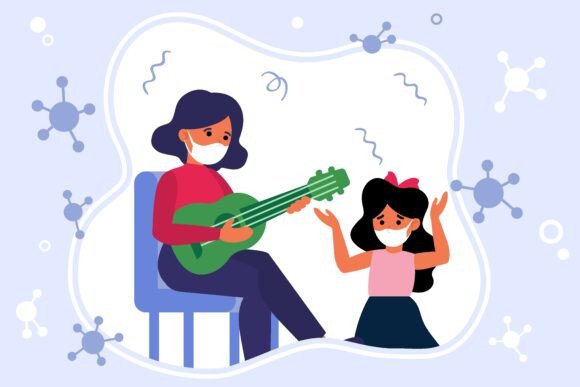
The landscape of education underwent a seismic shift when global health protocols forced schools to close their physical doors. Among the most affected disciplines was music, a subject that traditionally relies heavily on acoustic interaction, ensemble playing, and tactile guidance. The concept of a Music Lesson During Epidemic became more than just a logistical challenge; it transformed into a symbol of resilience and adaptability. At the heart of this transformation is the dynamic between the educator and the student, often visualized in resources like the "Teacher Pl" illustration, which captures a masked pupil learning guitar from an instructor. This imagery serves as a powerful metaphor for the new reality of musical instruction, where safety measures coexist with the enduring need for creative expression.
Visualizing Resilience in Educational Design
In the realm of digital content and web design, the narrative of remote music education has found a unique visual language. The vector illustration depicting a teacher strumming a guitar while a masked pupil observes represents a specific moment in history. It encapsulates the spirit of continuity amidst disruption. For designers creating landing pages or thematic banners, this type of imagery is invaluable. It communicates complex ideas about safety, persistence, and the universal power of art without needing extensive text.
The details within such designs—flat colors, clear lines, and the juxtaposition of traditional instruments with modern protective gear—resonate with audiences ranging from school administrators to parents seeking online tutoring. When we analyze the Music Lesson During Epidemic. Teacher Pl concept, we see more than just a graphic asset; we see a documentation of how society adapted. The illustration highlights the teacher's role not just as an instructor of technique, but as a guardian of cultural transmission during a crisis. The vivid coloring and engaging scene serve to uplift spirits, reminding viewers that education continues even when the methods change.
The Symbolism of the Masked Musician
The inclusion of a mask in educational illustrations is significant. It acknowledges the reality of the coronavirus context while refusing to let fear dominate the narrative. In a music lesson, the face is crucial for reading emotion, breathing cues, and articulation. A masked pupil challenges the teacher to find new ways to connect. Visually, this creates a striking contrast that draws the eye and prompts reflection. For business owners and educators looking to brand their online services, using such imagery signals empathy and awareness. It tells the consumer, "We understand the times, and we are here to help you navigate them safely."
Adapting Pedagogy for the Digital Age
Beyond the visual representation lies the practical reality of delivering high-quality instruction through screens. The transition from in-person to virtual music lessons required a complete reimagining of pedagogy. Teachers had to become tech-savvy troubleshooters, audio engineers, and motivational coaches all at once. The core objective remained the same: to foster growth and joy in the student. However, the tools and techniques shifted dramatically.
One of the primary challenges was latency. In a live performance, timing is everything. Over a video call, even a slight delay can disrupt rhythm. Educators developed strategies to work around this, focusing on individual practice rather than real-time ensemble playing. They utilized screen sharing to display sheet music, recorded demonstrations for students to watch at their own pace, and employed asynchronous feedback loops. This approach allowed for a deeper dive into technical theory and self-correction, skills that are essential for any musician but were previously secondary in a group setting.
New Tools for New Environments
The epidemic accelerated the adoption of digital audio workstations (DAWs) and collaborative software. Platforms that allow for multi-track recording enabled teachers and students to create duets despite being miles apart. A teacher could record a backing track, send it to the student, who would then record their part and return it. This workflow, while different from sitting side-by-side, offered unique advantages. It encouraged students to listen critically to their own playing and develop a stronger sense of independence. The "Teacher Pl" scenario, therefore, evolved from a simple one-on-one interaction to a complex, multi-layered production process that mirrored professional studio environments.
The Psychological Impact of Continued Musical Engagement
Musical education offers benefits that extend far beyond the acquisition of instrumental skills. It fosters cognitive development, emotional regulation, and social connection. During periods of isolation, these benefits became even more critical. The ability to maintain a music routine provided a sense of normalcy and structure for many families. For children, particularly, the continued engagement with music served as an emotional anchor.
Research suggests that making music reduces cortisol levels and alleviates stress. In a time defined by uncertainty and anxiety, the act of strumming a guitar or playing a piano key became a therapeutic outlet. The teacher's role expanded to include emotional support, helping students channel their feelings into their art. This aspect of the Music Lesson During Epidemic cannot be overstated. It was not merely about passing a grade or mastering a scale; it was about maintaining mental well-being through creative expression.
Building Community Through Isolation
Despite the physical distance, music managed to build bridges. Virtual recitals, online jam sessions, and shared playlists created a sense of community among students who would otherwise have been isolated. These digital gatherings demonstrated that the essence of music—the shared human experience—could survive the separation. The flat vector illustrations that depict these scenes capture the optimism of these moments. They show that while the classroom walls might have dissolved, the connections formed through music remained strong and vibrant.
Strategic Applications for Educators and Businesses
For professionals in the education sector, understanding the nuances of remote music instruction is vital for future planning. The hybrid model of learning, which combines online and in-person elements, is likely to persist. Schools and private studios must consider how to integrate the technologies and methodologies developed during the epidemic into their long-term strategies. This includes investing in better audio-visual equipment, training staff in digital communication, and developing curricula that leverage asynchronous learning.
Business owners in the creative industry can also draw insights from this period. The demand for digital content, including vector illustrations and educational materials, surged as organizations sought to communicate their message effectively. Using assets like the "Teacher Pl" design allows brands to align themselves with values of resilience and adaptation. It shows potential clients that the business is forward-thinking and responsive to current societal needs. Whether designing a website for a music school or creating a banner for a public health campaign, the right visual and textual combination can drive engagement and trust.
Optimizing Online Presence with Relevant Content
Search engine optimization plays a crucial role in connecting educators with students in the digital space. By utilizing semantic keywords related to remote learning, pandemic education, and musical instruction, websites can reach a broader audience. Content that addresses the specific challenges and triumphs of this era resonates deeply with users. Articles, blog posts, and resource pages that discuss the evolution of music lessons provide value to readers looking for guidance or inspiration. This approach aligns with E-E-A-T principles, demonstrating expertise and authority in a rapidly changing field.
Future Trends in Musical Education
As the world moves past the acute phases of the epidemic, the lessons learned will shape the future of music education. We are likely to see a permanent integration of digital tools into traditional teaching methods. The flexibility of online platforms will continue to offer opportunities for students who may not have access to local instructors or specialized instruments. Furthermore, the emphasis on self-directed learning and independent practice will remain a cornerstone of musical development.
The visual culture surrounding this shift will also evolve. Illustrations and media that celebrate the adaptability of educators and the resilience of students will continue to be relevant. They serve as historical markers of a time when humanity refused to let creativity be silenced. The image of a teacher and a masked pupil, connected through music, stands as a testament to the indomitable spirit of education. It reminds us that no matter the obstacles, the pursuit of knowledge and beauty will always find a way forward.
Sustaining the Momentum of Innovation
To sustain the momentum gained during this period, stakeholders must continue to invest in innovation. This includes exploring virtual reality (VR) and augmented reality (AR) technologies that could further bridge the gap between remote and in-person experiences. Imagine a future where a student can put on a headset and feel as though they are sitting in the same room as their teacher, seeing the finger placements in 3D. While we are not there yet, the foundation laid during the epidemic makes such advancements possible.
Ultimately, the story of the Music Lesson During Epidemic is one of transformation. It is a narrative of how constraints sparked creativity, how technology facilitated connection, and how the arts provided solace in difficult times. From the detailed vector illustrations used in web design to the actual pedagogical shifts in classrooms, every element reflects a commitment to the future of learning. As we look ahead, the legacy of this era will be defined not by what was lost, but by what was discovered and preserved through the power of music.