Teacher Talking to Student on Huge Compu: Redefining the Visual Language of Modern E-Learning
The landscape of education has undergone a seismic shift in recent years, moving from the physical confines of brick-and-mortar classrooms to the boundless digital frontiers of virtual learning. As institutions and platforms race to digitize their offerings, the need for visual assets that accurately reflect this transition has never been more critical. Enter the concept of Teacher Talking to Student on Huge Compu, a compelling flat vector illustration that encapsulates the essence of contemporary remote instruction. This is not merely a graphic; it is a symbolic representation of how technology has become the primary conduit for knowledge transfer in the 21st century.
The Evolution of Educational Imagery
For decades, stock photography and traditional illustrations dominated educational marketing materials. These visuals often depicted crowded lecture halls, chalkboards filled with equations, or students huddled over textbooks. While these images served a purpose, they increasingly failed to resonate with a demographic that consumes content primarily through screens. The modern learner expects an experience that mirrors their daily digital interactions—seamless, intuitive, and visually engaging.
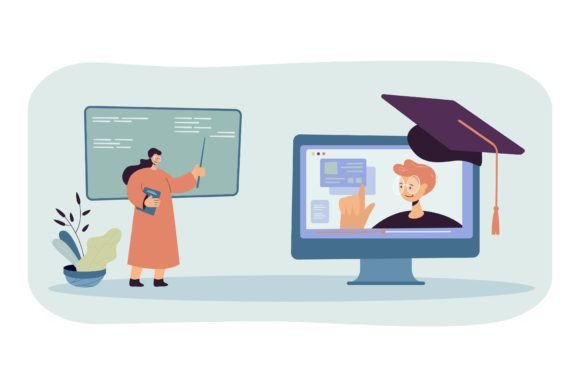
This is where the Teacher Talking to Student on Huge Compu illustration finds its footing. By depicting an educator in chic spectacles interacting with a student via a grand computer screen, the image bridges the gap between traditional pedagogy and modern connectivity. It acknowledges the reality that for millions of learners today, the "classroom" is a monitor, and the teacher is a presence within a digital interface. The flat vector style ensures scalability across various devices, from mobile phones to large desktop displays, maintaining clarity and impact regardless of the viewing context.
Symbolism in Digital Design
Great design communicates complex ideas instantly without the need for words. In this specific illustration, every element serves a narrative purpose. The "huge computer" is not just a prop; it represents the expansive potential of the internet and cloud-based learning management systems (LMS). It suggests that the world of knowledge is vast and accessible, waiting to be explored through the lens of technology.
Furthermore, the inclusion of a graduation cap perched proudly atop the monitor is a masterstroke of visual storytelling. It transforms the device from a mere tool into a gateway to achievement. This subtle detail reinforces the aspirational nature of education, reminding viewers that despite the medium of delivery, the ultimate goal remains the same: academic success and professional growth. For marketers and creators, this symbolism is invaluable when crafting campaigns that aim to inspire confidence in online degree programs or certification courses.
Aligning with Industry Trends and Consumer Expectations
The rise of the gig economy, the acceleration of upskilling initiatives, and the normalization of remote work have fundamentally altered consumer expectations. Professionals, entrepreneurs, and lifelong learners no longer view online education as a secondary option; it is often the primary method for acquiring new skills. Consequently, the visual identity of educational platforms must evolve to reflect this shift.
When we analyze current market trends, there is a clear preference for aesthetics that blend professionalism with approachability. The Teacher Talking to Student on Huge Compu graphic achieves this balance perfectly. The educator's "chic spectacles" add a touch of modern sophistication, suggesting that the instructor is not only knowledgeable but also attuned to contemporary culture. This humanizes the digital experience, combating the isolation that can sometimes accompany remote learning.
Moreover, the flat vector trend continues to dominate the UI/UX design space. Its clean lines and vibrant color palettes are optimized for fast loading times and high readability, which are crucial metrics for user retention on educational websites. As businesses invest heavily in digital transformation, they require assets that communicate efficiency and innovation. This illustration serves as a versatile asset that can be integrated into landing pages, email newsletters, and social media banners, ensuring a cohesive brand message across all touchpoints.
The Psychology of Virtual Connection
One of the most significant challenges in e-learning is establishing a sense of connection. Without the physical cues of a classroom, educators must rely on digital tools to build rapport. The imagery of a teacher and student engaged in conversation across a screen taps into the psychological desire for interaction. It validates the user's experience, signaling that the platform understands the nuances of virtual engagement.
By featuring a grand computer screen, the illustration emphasizes the scale of the interaction. It suggests that the dialogue is not limited by distance but is instead amplified by technology. This aligns with the broader industry movement towards immersive learning experiences, including virtual reality (VR) and augmented reality (AR), where the boundary between the physical and digital worlds continues to blur. Even if the platform does not currently utilize VR, using forward-looking imagery positions the brand as an innovator ready to embrace future technologies.
Practical Applications for Marketers and Creators
For professionals tasked with promoting educational services, the versatility of this graphic cannot be overstated. Whether you are managing a university website, running a freelance tutoring business, or developing a corporate training module, the ability to convey the right message quickly is paramount. Here is how this specific visual asset can be leveraged effectively:
- Website Hero Sections: Placing the Teacher Talking to Student on Huge Compu illustration at the top of a homepage immediately sets the tone for the visitor. It clarifies the service offering while creating an inviting atmosphere that encourages further exploration.
- Digital Banners and Ads: In the crowded space of online advertising, static images often get lost. A dynamic, well-composed vector illustration stands out against text-heavy backgrounds. The distinct elements—the glasses, the screen, the cap—create focal points that draw the eye and increase click-through rates.
- Content Marketing: Blog posts and articles discussing the future of education benefit from relevant imagery. Using this graphic alongside thought leadership pieces adds visual interest and reinforces the article's themes of technological integration and academic excellence.
- Onboarding Materials: New students often feel overwhelmed when navigating a new LMS. Welcoming them with friendly, relatable graphics like this one can reduce anxiety and foster a sense of community from the very first login.
Adapting to Changing Workflows
The workflow of modern content creation demands speed and adaptability. Flat vector illustrations are inherently modular, allowing designers to easily tweak colors to match brand guidelines or rearrange elements to fit different layout constraints. Unlike complex 3D renders or high-resolution photographs, vectors remain crisp at any size, making them ideal for responsive web design.
As organizations pivot towards agile marketing strategies, the ability to deploy high-quality visuals rapidly is a competitive advantage. The Teacher Talking to Student on Huge Compu concept provides a foundational asset that can be adapted for various campaigns without losing its core message. Whether the focus is on STEM education, language learning, or executive leadership training, the underlying theme of mentorship through technology remains universally applicable.
Connecting to Larger Developments in EdTech
The popularity of this type of illustration is not coincidental; it reflects a deeper transformation in the EdTech sector. As artificial intelligence and machine learning begin to personalize learning paths, the role of the human educator is evolving rather than disappearing. The image of the teacher talking to the student reminds us that technology is a facilitator, not a replacement, for human guidance.
We are witnessing a convergence of lifestyle and learning. Education is no longer confined to specific hours or locations; it is woven into the fabric of daily life. The "huge compu" represents this always-on accessibility. It signifies that learning can happen anywhere, anytime, provided there is a connection. This aligns with the growing trend of microlearning and just-in-time training, where professionals seek bite-sized knowledge to solve immediate problems.
Furthermore, as the global workforce becomes increasingly distributed, the ability to visualize cross-border collaboration is essential. This illustration transcends cultural barriers, presenting a universal scenario that resonates with audiences worldwide. It speaks to a shared aspiration for growth and the collective belief that technology can democratize access to quality education.
Conclusion: Embracing the Future of Learning
In an era defined by rapid technological advancement, the way we visualize education must keep pace with the tools we use. The Teacher Talking to Student on Huge Compu illustration is more than a decorative element; it is a strategic asset that communicates the values of modern e-learning. It blends the timeless pursuit of knowledge with the cutting-edge capabilities of digital platforms, creating a narrative that is both inspiring and practical.
For professionals, creators, and marketers, adopting such imagery is a step toward building brands that are relevant, trustworthy, and forward-thinking. It acknowledges the changing needs of learners who demand flexibility, interactivity, and a human touch in their digital experiences. As we continue to immerse ourselves in the world of e-learning, let us choose visuals that do not just depict the present but also illuminate the path to a brighter, more connected future. By integrating these thoughtful designs into our platforms and campaigns, we reinforce the concept that virtual learning is not just a temporary fix, but the enduring evolution of education itself.